

Canadian and U.S. markets provide different investment opportunities, and understanding the different sectors that make these indices – and the factors that could impact them – is crucial to understanding what any investor looking to participate in these markets is getting exposure to.
In the U.S., the markets are more liquid and have more depth, with high-growth sectors (technology and healthcare) and stronger historical returns. The Canadian market is reliable, with dividend-paying companies, exposure to a resource-rich economy and favourable domestic tax treatments. It’s also often seen as a safe haven when compared to the heavy tech concentration of markets in the U.S.
Canadian markets – S&P/TSX Composite Index
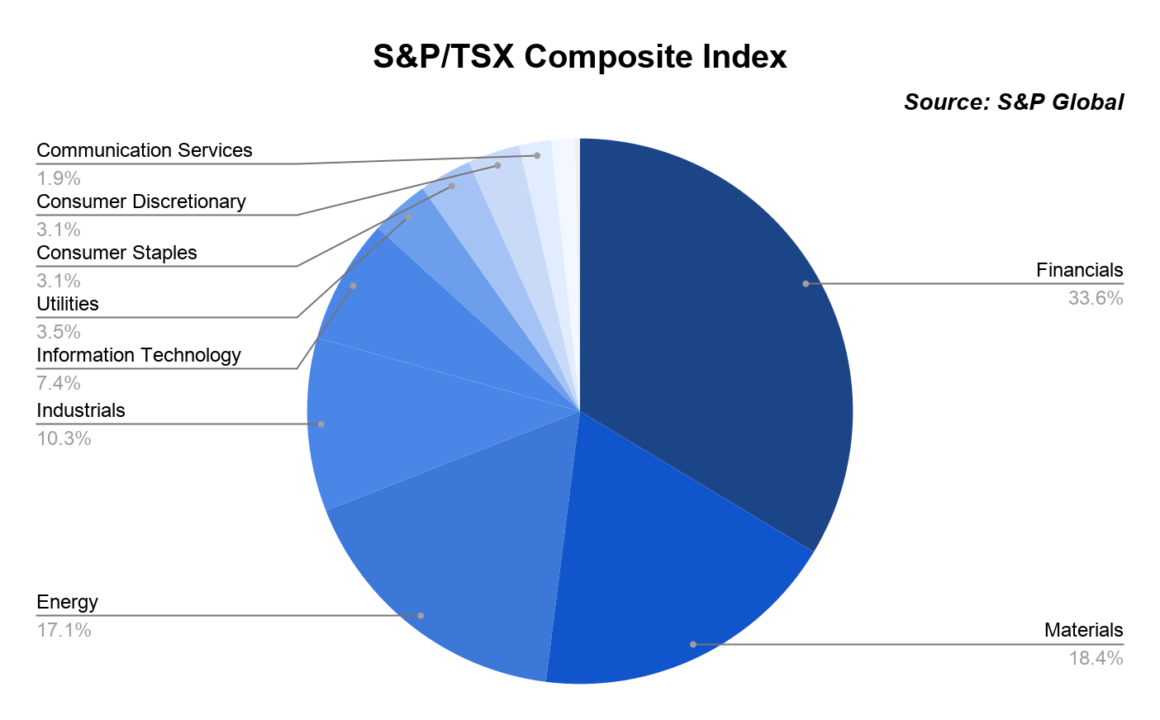
The main Canadian benchmark is the S&P/TSX Composite Index. It represents about 95 per cent of total market capitalization of all Canadian equities listed on the Toronto Stock Exchange S&P Global. The country’s biggest sector is financials sitting at 34 per cent, with materials, energy, and industrials coming in second.
Canada historically outperforms in energy and banking. For example, the S&P Canadian Energy Index has risen 240 per cent over the last five years, well outperforming the U.S.
Natural resources
Canada is separated into the resource-based West and the industrialized-service driven East.
This makes mining and natural resources a heavyweight in Canadian portfolios. British Columbia, Alberta and Saskatchewan are globally-renowned for their massive oil and gas reserves, mining, forestry and agriculture. That includes the Alberta oilsands, Saskatchewan’s potash production and British Columbia’s deposits of copper and metallurgical coal.
These natural resources play an important role in the country’s GDP and currency valuation, accounting for approximately 16 per cent of Canada’s nominal GDP and making up the majority of the country’s exports at 53 per cent.
The Canadian dollar (or “loonie”) is known as a petro-currency, since Canada is a top global oil producer. The loonie moves in tandem with the global crude prices. Crude oil is Canada’s primary export, so any rise in oil prices brings an influx of U.S. dollars into the country. That’s because higher demand for any local currency tends to drive up its value.
Heavy financials
Canada holds an outsized allocation of the S&P/TSX Composite Index in financials, which make up one third of the total Canadian equity market capitalization.
This sector is dominated by the regulated “Big Six” banks along with insurance conglomerates and asset managers overseen by the Office of the Superintendent of Financial Institutions (OSFI).
The major players of the industry include Royal Bank of Canada (RBC), Toronto-Dominion Bank (TD), Bank of Nova Scotia (Scotiabank), Bank of Montreal (BMO), Canadian Imperial Bank of Commerce (CIBC), and National Bank of Canada.
The financial sector has a big impact on the economy, accounting for 8.5 per cent of the country’s GDP. The sector is considered extremely safe, a distinction that has been achieved through strong federal regulation and supervision.
United States markets – S&P/500
Scale
The U.S. stock market is the largest in the world, sitting at a market capitalization of $75 trillion compared to Canada’s $4.5 trillion.
That depth means lower cost of capital, and enables U.S. capital markets to raise more funding and take more risks. The U.S. also has a more liquid market than Canada, which means investors require a lower risk premium – making capital cheaper.
U.S. markets also have:
- Enhanced funding for R&D: Companies can readily secure massive funding to expand and take high-reward risks.
- Higher merger and acquisition rate: U.S. corporations can leverage their massive valuations to pursue global mergers and acquisitions.
Technology sector
The U.S. technology sector is globally dominant, and it’s also a multi-trillion dollar economic engine. This sector is the epicenter of worldwide innovation in AI, cloud computing and semiconductors. It also has access to huge venture capital pools.
The “Magnificent 7” are the major players in the U.S. technology sector, which includes Alphabet, Amazon, Apple, Tesla, Meta, Microsoft and Nvidia.
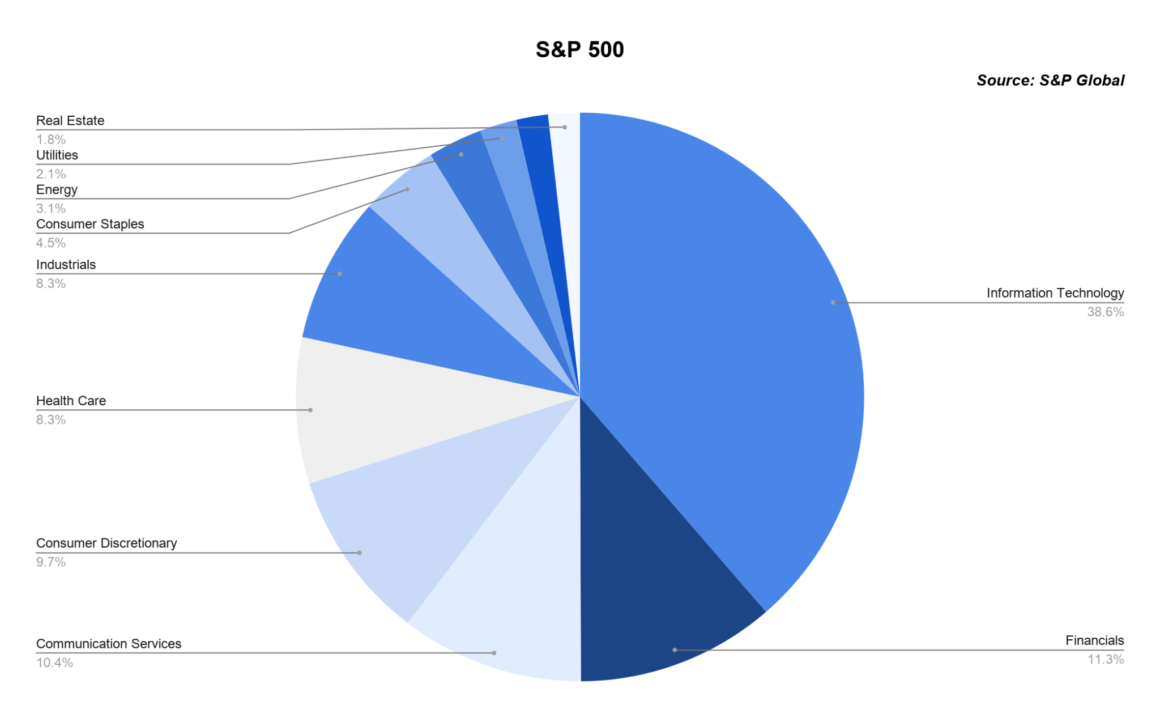
These mega-caps (a publicly-traded company with a market capitalization of $200 billion or more) have massive valuations, making them vulnerable to volatility, which means tech slowdowns can impact a portfolio. As a whole, the Magnificent Seven have a combined market capitalization of approximately $22.7 trillion, representing over one third of the S&P 500, sitting at around 39 per cent.
Market Trends
Historically, the U.S. markets (S&P 500) have outperformed the Canadian equivalents (S&P/TSX Composite). The U.S. has compounded at 13 per cent over the last 10 years compared to Canada’s 10 per cent.
This is driven by the U.S. concentration in the high-growth technology sector, compared to Canada’s reliance on the stable, cyclical sectors.
The S&P 500 also operates as a growth index, benefitting from capital appreciation and earnings expansion. The TSX operates as a value index, looking more toward capital-intensive, cyclical assets. It also pays out larger distributions in dividends rather than focusing on stock price appreciation.
Canada is also impacted by the cyclical nature of its economy. The U.S. has diversified global earnings, but Canadian markets are more sensitive to commodity prices and global growth.
When global GDP stalls, the TSX does too. When commodities boom, the TSX will outperform. For example, in 2025, the TSX returned 31.46 per cent where the S&P 500 returned 17.39 per cent.
Choosing between the U.S. and Canadian markets is not about picking a winner, it’s about balancing growth with stability.
While the S&P 500 provides an aggressive, tech-forward engine for long-term capital appreciation, the TSX offers a defensive, income-generating anchor rooted in essential financial and natural resource sectors.
For most investors, the ideal strategy leverages the unique strengths of both nations to build a diversified and resilient portfolio – a trade-off anyone looking at investing in these markets should run through their financial advisor.