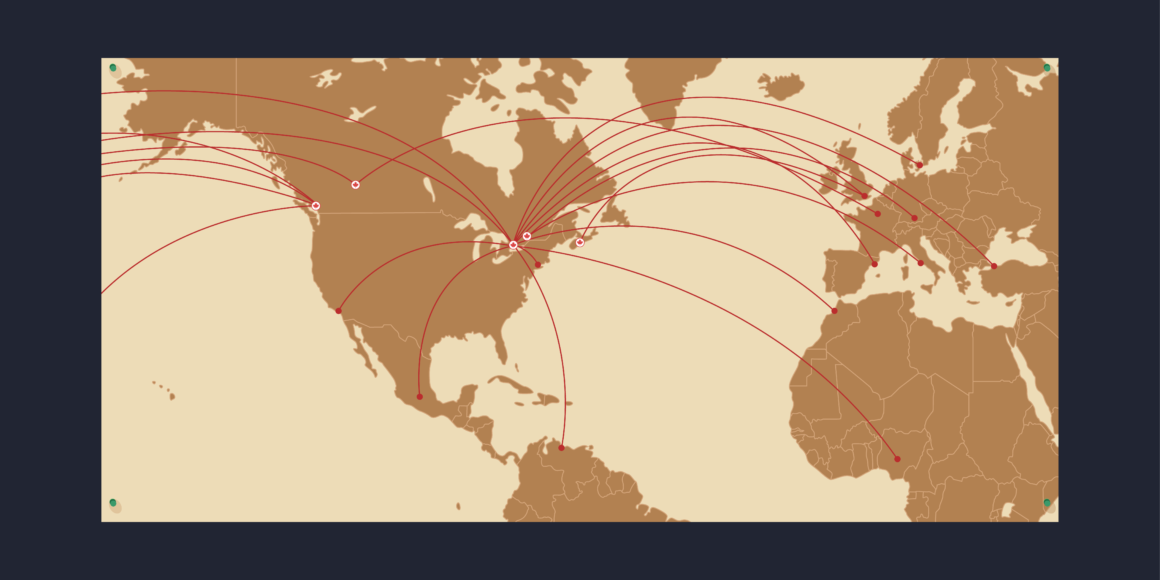

Across pensions, endowments and retail portfolios, capital is increasingly flowing outside of Canada because investors see better opportunities elsewhere. The result is a growing decapitalization trend, where domestic capital is deployed abroad rather than being reinvested at home.
This is reshaping Canada’s capital markets in real time, with consequences visible not just in portfolios, but in the structure of the country’s capital market.
Initial Public Offerings (IPOs) and Market Structure
Canada has seen a significant decline in IPOs, lower deal volume and more cautious listings. The slowdown in IPO activity further reinforces the weakness in corporate investment, as fewer firms are choosing to raise public capital in uncertain market conditions and are leaning toward private equity.
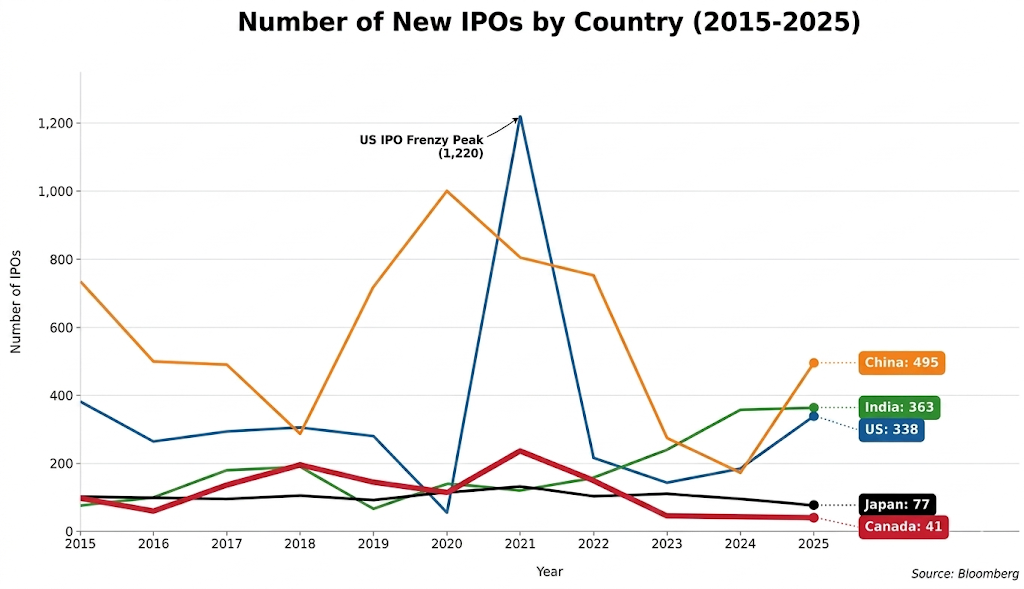
Despite being a top global economy, Canada consistently ranks among the lowest IPO activity, highlighting a structural weakness in its capital markets. This suggests that while capital exists domestically, fewer companies are choosing to access public markets ultimately reinforcing the broader trend of cautious corporate investment.
M&A levels
In 2025, the total value of mergers and acquisitions (M&A) in Canada for the full year was around US$390 billion. The main industries included utilities with a deal value of $72 billion, energy at $62 billion, and mining at $61 billion.
In 2024, the total value of M&A transactions for the full year was approximately $272 billion, suggesting that 2025 experienced a 43 per cent increase in M&A transactions.
Despite a sharp rise in M&A activity in 2025, the trend does not necessarily signal stronger long-term investment in Canada. With total deal value increasing capital is active, but much of it is flowing to takeovers in established sectors, pointing to a preference for stable cash flows over new growth and innovation.
At the same time, this surge in M&A contributes to a broader “decapitalization” trend where Canadian companies are taken private or acquired at lower valuations.
This reduces opportunities in public markets and suggests Canada is being viewed more as a source of undervalued assets than a destination for long-term capital.
Investor patterns
This seems to be particularly true when it comes to bonds and real estate. Investors seem to prefer to lend money to the government at 3.4 per cent than bet on Canadian corporate growth. The country currently holds $33.6 billion of foreign investment in AAA quality Canadian debt.
Amidst ongoing trade wars with the U.S., capital expenditures have stalled, innovation appears to be on hold and businesses have switched gears to focus on inventory over innovation.
The high cost of doing business in Canada mixed with U.S. tariffs has been keeping domestic capital on the sidelines, making it hard for Canadian companies to grow their equity values.
Institutional investors
Institutional investors (asset managers, REITs, pension funds) are starting to increase their activity in real estate, infrastructure and private markets.
For example, 81 per cent of Canadian institutional investors ranked the private market environment as the most favourable investment opportunities. If the historical trend showed capital leaving Canada, today’s allocations show where it went.
Maple 8 pension funds
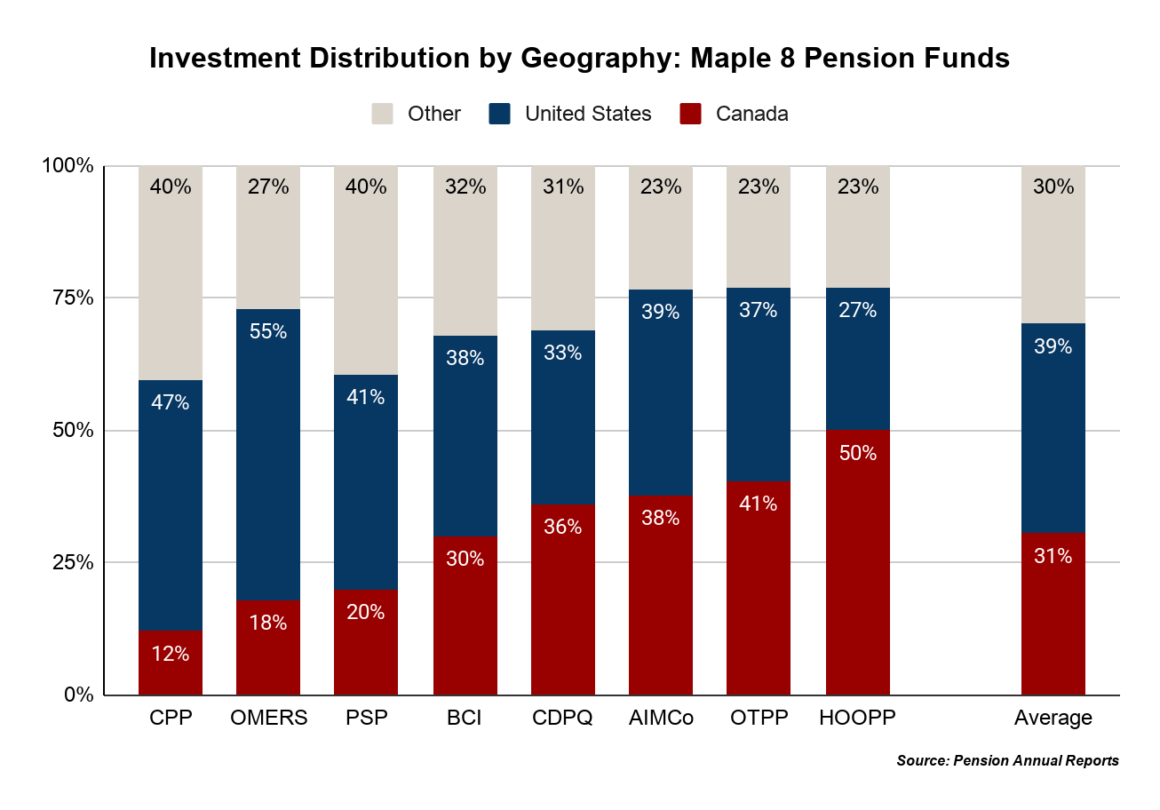
Canada’s pension funds (the “Maple 8”) control approximately $2.6 trillion in assets. However, the largest allocation is to the United States, sitting at 39 per cent, compared to the Canadian allocation of 31 per cent.
In 2015, the pension funds dedicated about 45 per cent of funds to Canadian investments, which is a 14 percentage point decrease from 2015 until 2026.
The largest of the Maple 8 is Canada Pension Plan (CPP), which has the lowest Canadian investment at 12 per cent. Additionally, the Ontario Municipal Employees Retirement System (OMERS) has a huge allocation of 55 per cent in the U.S.
Canada has capital ready – about $3 trillion – to be invested domestically, but experts say many investors are waiting for government-backed projects or better investment opportunities.
However, certain companies are beginning to see the value of investing in Canada. For instance, RBC is looking to launch a growth fund with US$725 million in Canadian companies. OMERS is also aiming to invest at least $10 billion in new Canadian projects over the next five years to raise their allocation from 18 per cent to 25 per cent.
University endowments
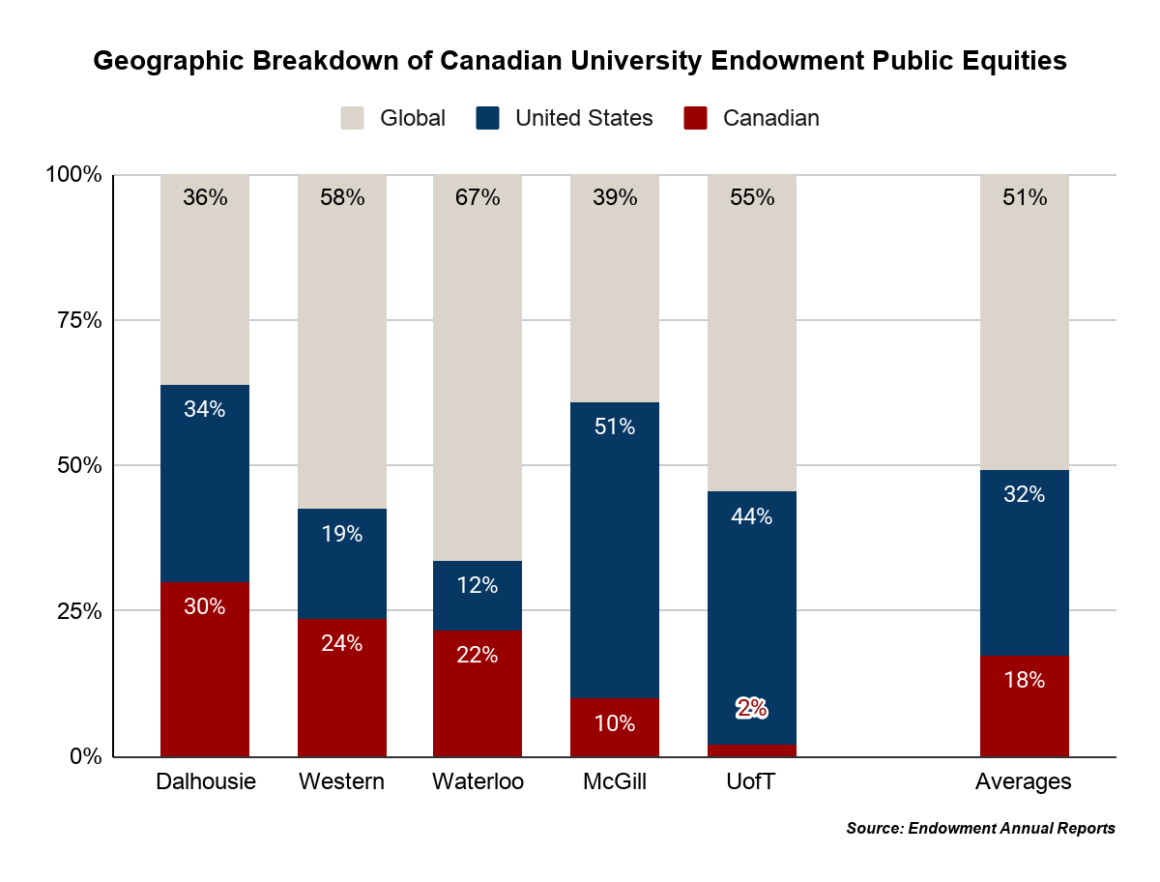
Across major university endowments, domestic equity exposure remains relatively low, averaging around 18 per cent, compared to the 32 per cent in public U.S. equities, and more than 50 per cent globally.
Schools like UofT and McGill allocate as little as two and 10 per cent to Canadian equities, highlighting a clear preference for international markets.
In 2015, endowments allocated around 34 per cent to Canadian equities, which is a 16 percentage point decrease from 2015 until 2026.
This suggests that even long-term Canadian investors see greater opportunity outside the domestic market, driven by deeper capital markets, stronger growth prospects, and broader diversification.
Insurance companies
Life insurance companies are among the largest institutional investors in Canada. These long-term investment giants, which include Sun Life Financial, Manulife Financial, and Great-West Lifeco ,hold $1 trillion within Canada to support national economic growth.
Of that total, insurers held $50 billion in domestic infrastructure assets, such as bridges, hospitals and energy projects.
The Canadian life and health insurance industry holds approximately $5 trillion, suggesting that the domestic commitment of these giants is still only around 20 per cent.
Mirroring the sector’s conservative approach, these companies allocate approximately 40 per cent of their total assets to bonds and fixed-income securities – which supports the argument that Canada is a safe haven for debt, while exporting growth-seeking capital abroad.
Retail investors
Retail investors remain a core part of the Canadian capital markets, making up 35 per cent, especially in ETFs, mutual funds and passive investing. The participation has remained elevated post-pandemic, with a strong home bias that is gradually decreasing.
The $735 billion Canadian ETF market has become the primary vehicle for the capital flights. While the industry saw a record $122 billion inflow in 2025, those dollars are increasingly bypassing the TSX in favor of U.S. large-caps. We can see this by looking through ETF portfolios.
For example, XEQT (iShares Core Equity ETF Portfolio) is a Canadian ETF managed by BlackRock Canada, and holds 43.34 per cent of the fund in United States assets and 24.59 per cent in Canadian assets.
Active ETFs now represent 28 per cent of the total market, growing 15 times faster than traditional passive funds.
Additionally, retail interest in options-based equity funds has surged. By selling call options on the TSX 60, these funds are turning a stagnant domestic market into a high-yield alternative to GICs.
Retail investors have also become increasingly interested in alternatives. Canadian-listed crypto ETFs now manage almost $6 billion in assets, with bitcoin focused funds like Fidelity leading the group.
Despite positive real GDP growth of 1.7 per cent, Canada’s capital markets are witnessing a departure as domestic investment pivots toward foreign opportunities.
This may be due to a structural flaw in our major players and a lack of diversification.
With Canadian bank stocks, insurance firms, and other financial providers representing 30 per cent of the S&P/TSX, the financial sector has arguably become overvalued. This makes it hard to find an entry point into companies existing in the sector, or investors may just find this huge sector allocation of the index risky.
As a whole, institutional investors still dominate trading, but retail investors are an influential force, accounting for 6.4 per cent of ETF trading volume. Retail investors tend to dominate certain segments such as money market funds, where retail investors held approximately 65 per cent of the total assets of Canadian MMFs, while institutional investors held only 14 per cent.
Foreign investment
Foreign investment in Canada is high, with other countries investing heavily in Canadian debt, while the Canadian investment in itself is low. With $51.3 billion foreign investment in bonds and only $5.7 investment in equities, it’s clear where investors find value in Canada.
For every dollar going into Canadian equities, nearly $9 is being lent as “safe debt.”
| Asset Class | Foreign Flow (Net) |
| Corporate Bonds | +$31.5 billion |
| Federal Bonds | +$12.9 billion |
| Equity | +$5.7 billion |
| Money market | -$10.2 billion |
In 2025, Canadian investors increased their exposure to foreign securities by $133.8 billion. Of that exposure, $84.2 billion went toward U.S. corporate shares. For every dollar a Canadian puts into a domestic investment, they’re putting almost $15 into a foreign one, ultimately exporting wealth to fund the next generation of U.S. innovation.
The numbers show Canada has become a net exporter of its capital, sending its best money abroad while it leaves the remnants at home with low growth.