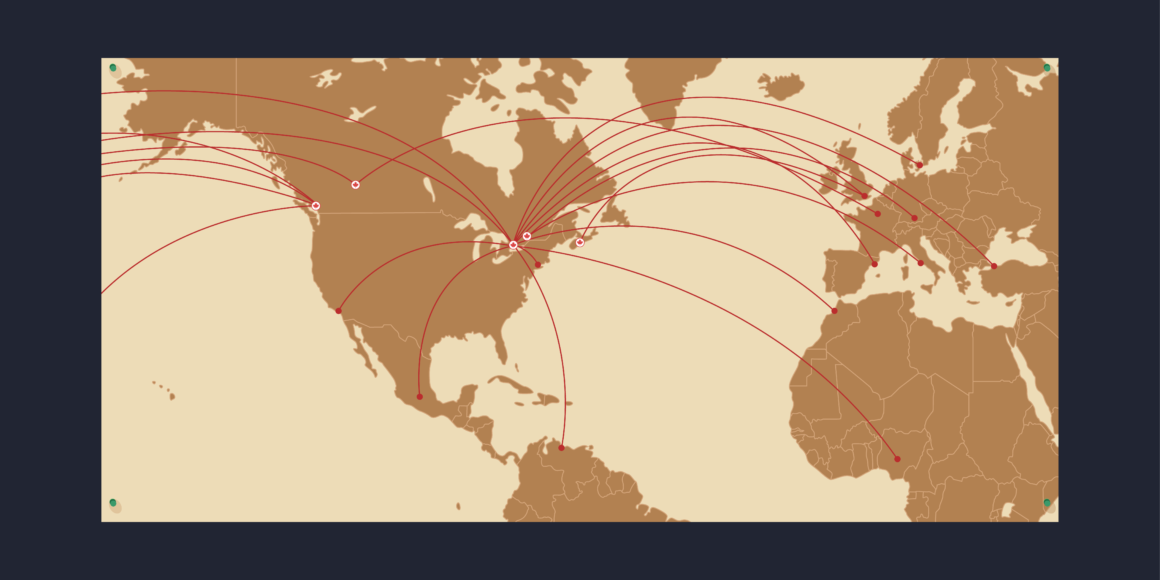

Foreign direct investment (FDI) has been a key driver of Canada’s economic growth. It brings in capital, creates jobs and connects the country to global markets. But in today’s environment, the flow of foreign capital into Canada tells a more nuanced story.
As global competition for investment intensifies and domestic challenges mount, the question is no longer just how much capital is coming in, but where it’s going – and what that means for Canada’s economic future.
FDI over the last two years
In 2025, Canada reached its highest foreign direct investment level since 2007, with $96.8 billion coming into the country, up from $86.6 billion in 2024. In 2024, 38.5% of FDI went into energy projects, with 96.2% representing new investments. Canada’s energy sector remains the main draw for foreign capital, given the country’s ability to combine established oil and gas opportunities with firms working on the clean energy transition.
Types of FDI
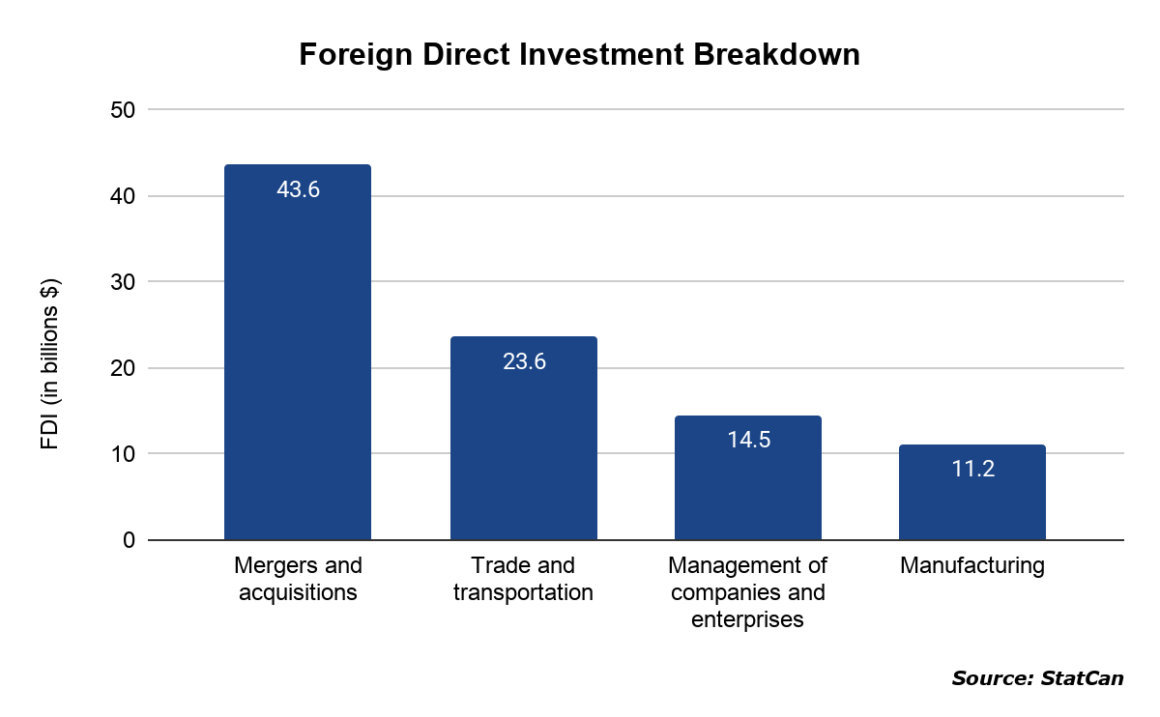
In 2025, mergers and acquisitions dominated FDI, accounting for $43.6 billion, which points to acquisitions of existing firms driving investment, rather than new business creation. While trade and transportation, manufacturing and management attracted some capital, they played a smaller role, suggesting FDI is more focused on ownership changes than new economic expansion.
FDI by country
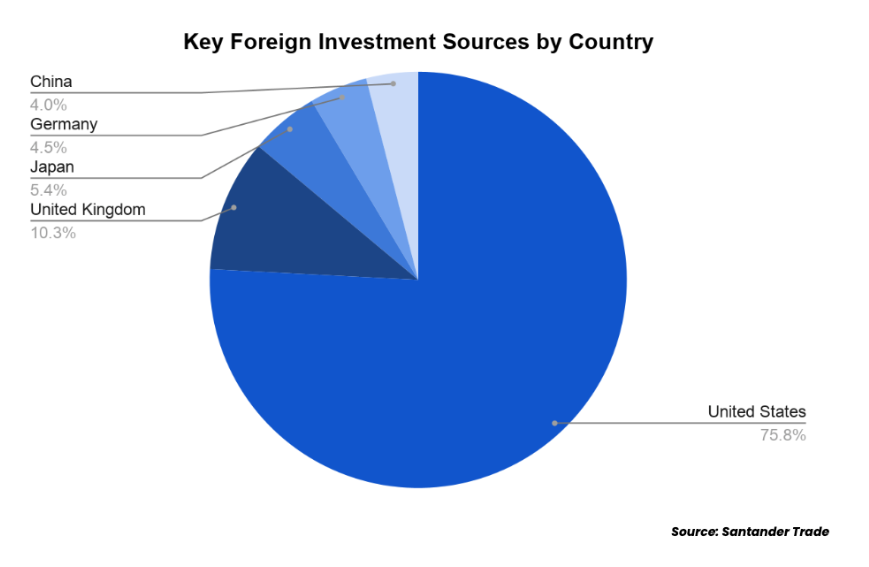
In 2024, the United States was the main foreign country to invest in Canada, accounting for 75.8% of total inflows. The United Kingdom followed at 10.3%, with Japan, Germany and China rounding out the rest. At that time, there was still a heavy reliance on U.S. capital, with limited diversification across other global investors.
Companies and projects
In 2024 and 2025, FDI activity reflected a mix of large-scale industrial investments and technology-driven expansion, with major global firms committing capital across sectors such as EV manufacturing, cloud infrastructure and energy.
The 10 largest projects in the last few years include:
| Company | Investment in Canada | Description |
| Stellantis | Investing over $8.6 billion in Canada – $3.6 billion has been allocated toward a retooling commitment, and a $5 billion investment is going toward a joint-venture battery factory. | From the Netherlands, Stellantis is a global automaker and mobility provider that was created in 2021 through the merger of Fiat Chrysler Automobiles and the French PSA Group. |
| Amazon/AWS | Investing over $65 billion in Canadian operations since 2010. Working on expanding logistics, AWS data centers, and corporate footprint. Created over 46,000 jobs, supported 70 logistics sites, and has $55 billion in estimated GDP impact. | Amazon is a technology company focused on e-commerce, cloud computing, and AI. AWS is its subsidiary that is focused on providing on-demand cloud computing services. |
| General Motors (GM) | Since 2020 GM has invested a total of $1.5 billion, with a focus on EV and truck production. It has added an additional $63 million in 2026, which is a part of the $1.5 billion. | General Motors is an American automotive corporation that focuses on designing, manufacturing, and selling vehicle parts worldwide. |
| Volkswagen | In 2023, Volkswagen invested $7 billion into an electric vehicle battery cell manufacturing gigafactory. | Volkswagen is a German automotive manufacturer. It produces cars, commercial vehicles and motorcycles, as well as offering financial services. |
| Rio Tinto Group | Rio Tinto engaged in a $6.7 billion acquisition of Arcadium Lithium in March 2025. This allowed the company to expand its share in the energy transition materials space. | Rio Tinto is a British-Australian mining and resources company. It’s one of the largest producers of iron ore, aluminum, copper and lithium. |
| BHP Group | Invested over $14 billion in the Jansen Potash Project, which is projected to become one of the world’s largest and most sustainable potash mines. | BHP Group is the world’s largest mining company from Australia. It’s a natural resources company that explores, develops and produces iron ore, copper, metallurgical coal and potash with interests in nickel and uranium. |
| Asahi Kasei | Invested $1.6 billion in Ontario, building the first Canadian industrial-scale Hipore wet-process lithium-ion battery separator plant. This involves a joint venture with Honda to supply the North American EV market. | Asahi Kasei is a Japanese chemical/industrial company that operates in the material, homes, and healthcare sectors. It’s known for chemical products, housing, medical devices and electronic components. |
| IBM | $1 billion over five years to expand a semiconductor assembly, testing, and packaging plant. | International Business Machines Corporation is an American technology company that specializes in AI, hybrid cloud computing and quantum computing. Its focus is on enterprise solutions, IT consulting and research. |
| Ford | Invested $3 billion to expand Super Duty truck production. Previously, there was a $1.3 billion investment into a Canadian plant for EV production which was delayed until 2027. | Ford Motor Company is an American automaker. It’s known for pioneering the assembly line producing cars, trucks, SUVs and electric vehicles. |
| Linde | Invested $2.6 billion into building and operating a clean hydrogen facility that will supply Dow’s Path2Zero Project. | Linde is a United Kingdom industrial gases and engineering company. It’s known as the world’s largest industrial gas supplier, serving industries that include healthcare, chemicals, energy and electronics. |
Other large projects include:
- Ubisoft – $950 million on production studio, accelerator and training programs
- Sanofi – $927.9 million on an influenza vaccine production facility
- Mastercard – $663.5 million on global intelligence and cyber centre
- Braya Renewables – $509 million on acquisition of a diesel refinery
- Roche – $500 million on pharma technical operations
- DeBeers – $436 million on land to expand diamond mine
- Cargill – $350 million on canola processing factory
- Google – $327.7 million on expansion
- Dow – $276 million on expansion of an ethylene and derivatives plant
Other large names investing in Canada include Berkshire Hathaway Energy Canada, Netflix, Microsoft, POSCO Chemical, Cenovus, Imperial Oil, and Suncor to name a few.
FDI and economic prosperity
Foreign direct investment remains a fundamental driver of global economic activity, shaping how capital, ideas and opportunities move across borders.
Beyond the numbers, it reflects where investors see long-term potential and how economies position themselves to grow. That makes understanding FDI essential not just for tracking investment flows, but for interpreting the broader direction of the global economy.