

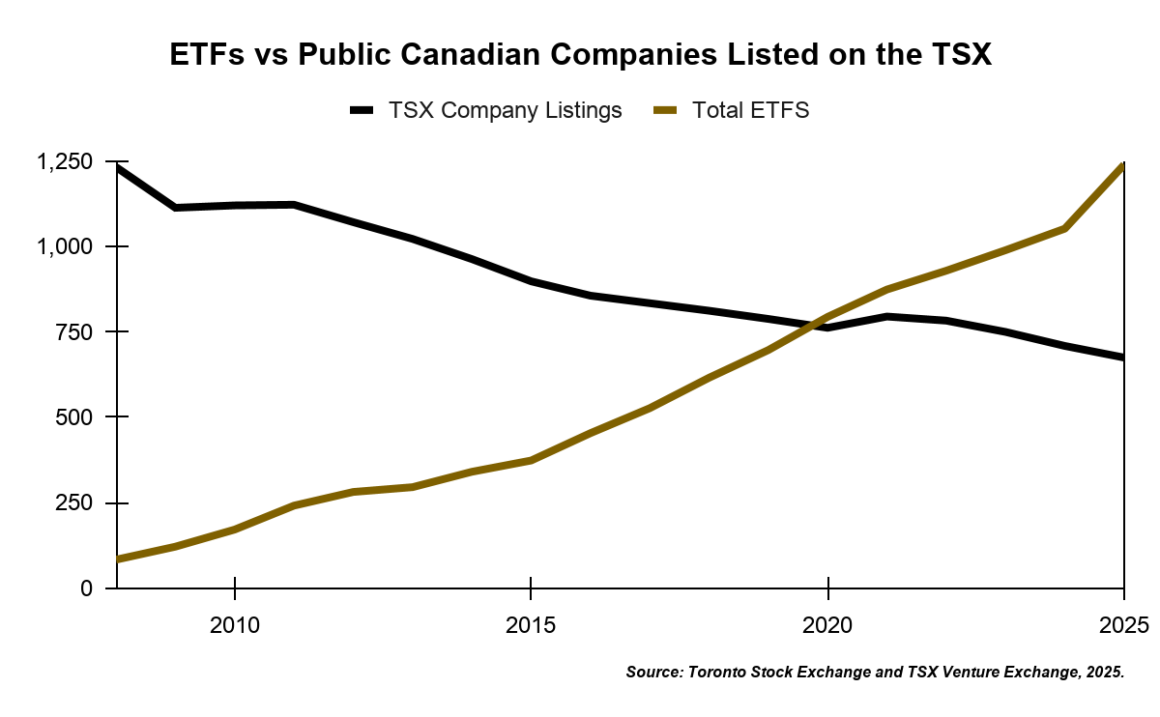
Canada’s public equity markets are quietly evaporating. Between 2008 and 2025, the number of companies listed on the TSX plummeted to less than 700 in 2025, down from 1,232 in 2008 – a 45 per cent drop.
In 2010, the exchange had 39 Initial Public Offerings (IPOs) but by 2025,that number had slowed to just two.
It’s a decline that reflects several structural changes occurring across Canadian capital markets.
Mergers and acquisitions
The traditional corporate story used to end with an IPO. Today, it frequently ends with a buyout. Many companies are being acquired before they ever reach the public markets.
Over the last three years, there has been a 68 per cent increased the Canadian M&A landscape:
| Year | M&A value for the year (in US billions) |
| 2023 | $231.84 |
| 2024 | $271.69 |
| 2025 | $389.69 |
According to the Fraser Institute, the shrinking pool of public listings is partly due to increased merger and acquisition activity.
That corporate consolidation removes established companies from public exchanges much faster than new businesses are replacing them. It’s a global phenomenon where approximately 34,000 companies delisted from stock exchanges worldwide between 2005 and 2023.
For founders, selling a company often provides a faster, cleaner and more certain exit strategy than pursuing the unpredictable path of an IPO.
While Canadian start-ups may have great ideas and significant growth potential, they frequently exit too early by selling to foreign buyers when Canada’s domestic landscape fails to foster the kind of innovation required to scale these businesses into massive giants.
As a result, Canada misses out on building the next generation of market leaders, falling behind the aggressive growth seen in the U.S.
For instance ATI Technologies – a global pioneer in GPUs founded in Markham, Ont., was acquired by AMD, a U.S.-based semiconductor giant, for $5.4 billion in 2006 instead of continuing its growth journey in Canada.
The availability of private capital
There was a time when companies had to go public if they wanted to raise massive growth capital. Today, that monopoly has been challenged. Companies no longer need public markets to raise growth capital.
Private equity assets under management in Canada have grown, skyrocketing from approximately $12.8 billion in 2008 to $93.2 billion in 2024, an increase of 628 per cent. Because private capital has become so readily available, companies can comfortably choose to remain private for much longer periods of time. As well, CAD $56.5B was invested in Canadian private equity by Q3 2025, the strongest nine-month period on record.
Instead of courting public investors, firms can now raise substantial funding from private equity firms, pension funds, venture capital funds, and family offices. This is all while completely avoiding the heavy financial costs and rigorous reporting requirements associated with public markets.
Lack of financial incentives
For modern businesses, the benefits of going public are no longer obvious.
Historically, an IPO was a company’s gateway to capital that was otherwise difficult to obtain. Today, deep-pocketed private financing pools offer similar capital, but with a major bonus: fewer disclosure requirements and far less regulatory oversight.
This shift has ultimately led to a dramatic decline in IPOs. From 2008 to 2013, Canada averaged a healthy 47 IPOs annually. Between 2014 and 2024, that annual average plummeted to just 16, hitting a rock-bottom low of only 5 IPOs in 2024 on Canadian exchanges.
At the same time, public companies must shoulder significant, ongoing legal, compliance, audit, and investor-relations costs; financial and administrative burdens that private firms can simply avoid.
Innovation gap and declining productivity growth
The underlying weakness of Canada’s public markets may also mirror a deeper, more troubling economic reality.
It can be argued that Canada’s lackluster business investment, weak productivity growth, and slower pace of innovation have reduced the number of companies capable of scaling to the size necessary to become attractive public market candidates. When a country produces fewer high-growth companies, it naturally leaves fewer IPO candidates to enter Canadian exchanges.
It has also led to a 40% reduction in publicly traded companies on the Canadian exchanges from 3,520 in 2008 to 2,114 in 2024. While it is normal for a company to mature through the business cycle and eventually delist, the issue is the lack of IPOs and new listings that should replace those companies that are leaving.
According to the Investment Industry Association of Canada’s article Re-Energizing Canada’s Public Equity Markets, the Canadian market recently faced an 18-month drought without a single new issue. Commenting on this stagnation, the CEO of the TMX Group noted, “I don’t think we take enough risk.” This risk-averse environment ultimately drives Canadian institutional investors to look abroad, preferring U.S. markets where a greater willingness to take risks yields the higher returns they seek.
Regulations
Operating in the public eye requires a heavy commitment to disclosure and governance obligations. While these strict transparency and governance requirements are designed to protect investors, they also dramatically drive up the cost of being a public entity.
Smaller and mid-sized companies, in particular, often find that the burden of compliance far outweighs the benefits of being listed on an exchange. As private capital becomes more accessible and frictionless, these steep regulatory costs act as an increasingly powerful deterrent to pursuing an IPO.
Growth of index investing
The rise of ETFs and passive investing has changed the structure of Canadian markets. According to the Fraser Institute, the number of ETFs available to investors ballooned from just 84 in 2008 to 1,239 by 2025.
As passive funds continue to attract the larger share of global investment assets, capital automatically flows toward the massive, established corporate giants already included in major indexes. This structural shift starves smaller public issuers of the visibility and liquidity they need to survive.
The decline in Canadian IPO activity is not the fault of any single factor. Instead, it is the result of a powerful perfect storm: a combination of aggressive merger activity, abundant private capital, heavy regulatory costs, weaker productivity growth, and the rise of passive investing.
The statistics are striking:
- TSX listings down nearly 50 per cent since 2008
- IPOs down more than 90 per cent since 2010
- Private equity assets up more than 600 per cent
- ETFs up more than 1,100 per cent
As private markets continue to expand, the challenge for policymakers and market participants will be ensuring that public markets remain an attractive destination for Canada’s next generation of growth companies.