

When evaluating global investment destinations, the Canadian and U.S. banking frameworks represent two of the most robust, yet distinct, financial systems in the world.
Canada operates a heavily-consolidated, protective oligopoly that prioritizes system resilience. The United States, by contrast, relies on a hyper-competitive, decentralized network that serves as a hub for technological innovation and product diversity.
A recent interview conducted with Robert Wessel, executive chairman and co-founder of Hamilton ETFs, highlighted a critical point about this dynamic: understanding the true relationship between these two systems requires moving past a simple matchup of safe versus risky. The U.S. and Canadian frameworks are fundamentally equivalent in their ultimate economic utility, but they have different structural trade-offs.
The modern cost of the oligopoly: The state of our Big Six
While there has been consolidation in the U.S. banking sector, there is still a significant presence of competition outside the largest companies across the entire financial services sector.
The massive, systemically important Wall Street institutions operate with strict capital thresholds and cushions that mirror or exceed peers. However, the hundreds of smaller regional and mid-cap banks beneath them are forced to compete by lowering consumer fees, adopting fintech innovations and expanding credit access to capture market share.
Investment banking and full service brokerage absorbed
The centralized power of the Canadian banks is a direct result of the interventions as of the late 1980s. Since the Great Depression, both Canada’s and the U.S. financial system was governed by the four pillars: Commercial banks, mortgage lenders (trust companies in Canada; thrifts in the U.S.), investment banks and insurance companies.
In 1987, fearing that Wall Street investment firms would buy up independent Canadian brokerages, the federal government dismantled the four pillars, allowing Canada’s commercial banks to acquire almost all major independent investment dealers which included their network of investment advisors. That led to deals like Royal Bank acquiring Dominion Securities and Canadian Imperial Bank of Commerce buying Wood Gundy. Toronto-Dominion Bank was left out of this consolidation, and sought to build its own investment banking capabilities, which was supported by its acquisition of Newcrest Capital in 2000.
The reason for this change was to ensure that the Canadian capital markets were owned and controlled by Canadians. However, by marrying corporate banking with commercial balance sheets, independent investment dealers were severely diminished. That critical funding pipeline is now controlled by the Big Six, tying underwriting and advisory access to corporate lending. Over time, this has made it more difficult for small and mid-market competitors to access growth capital.
Migration to private equity
Because the Big Six face minimal domestic competition and operate with uniform risk parameters, they can afford to keep their business credit criteria risk-averse. Startups, small businesses and early-stage innovators find it harder to secure capital in Canada than in the highly dynamic, competitive U.S. ecosystem. Canadian commercial banks prefer low-risk, asset-backed lending over entrepreneurial corporate loans.
Today, if an expanding Canadian business requires growth capital, it rarely turns to a Big Six commercial loan program. Instead, capital deployment has shifted heavily into alternative asset pools, private credit markets, and U.S. private equity firms. While this structural insulation protects everyday Canadian retail depositors from corporate credit defaults, it makes it difficult for small and medium-sized companies to expand, which has a negative impact on economic growth and productivity.
The architecture of Canadian banking
Canada’s banking system is organized into three distinct schedules under the federal Bank Act:
- Schedule I – Domestic Banks: Canadian-owned institutions that are widely held, meaning no single shareholder can control more than 20 per cent of voting shares. This schedule includes the country’s dominant Big Six, with 36 banks falling into this category in Canada.
- Schedule II – Foreign Bank Subsidiaries: Foreign-owned institutions that are incorporated in Canada and permitted to accept retail deposits, such as Amex Bank of Canada and ICICI Bank Canada. There are 15 of these in Canada.
- Schedule III – Foreign Bank Branches: Foreign institutions permitted to operate as full-service branches within Canada. There are 28 of these in Canada including Citibank and Wells Fargo.
While there are more than 80 banks operating in Canada, the domestic marketplace is highly centralized. The landscape is weighted by the Big Six: Royal Bank of Canada, Toronto-Dominion Bank, Bank of Nova Scotia, Bank of Montreal, Canadian Imperial Bank of Commerce and National Bank of Canada. Ninety three percent of all Canadian deposits are controlled by the Big Six, as well as Desjardins. Since the market is so tightly consolidated, consumer options are compressed, resulting in highly uniform product offerings and fee structures across the country.
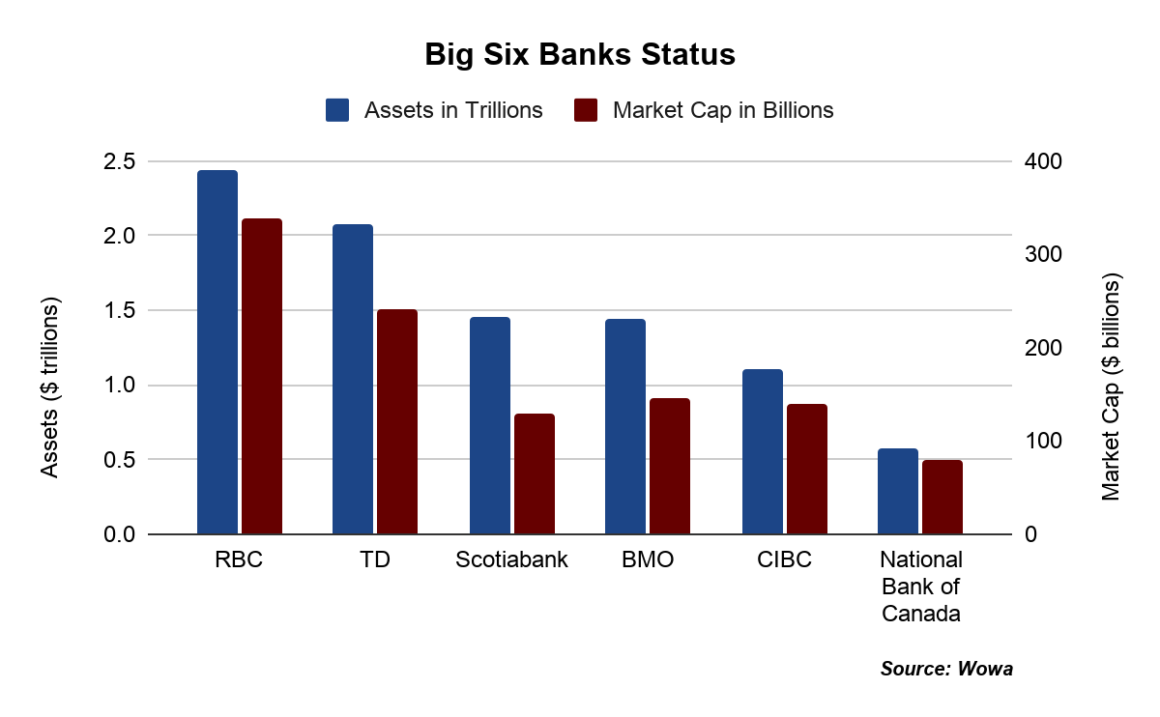
Many investors consider these core institutions some of the best defensive and dividend-paying stocks on the TSX.
Ultimately, the Canadian and U.S. banking architectures present structural trade-offs. The fragmented U.S. system experiences regular regional turnover as the natural price of a dynamic economy that fuels small business scaling, rapid fintech adoption and capital velocity.
Canada, conversely, has structured its system to trade away hyper-competitive innovation in exchange for structural security. The result is a highly defensive financial core that grows slowly, charges higher friction costs, but is heavily protected from collapse.