
While you may be ready to jump right into being in love, you may want to think about being a bit more cautious when it comes to money. Merging bank accounts may help some couples feel like they are building a life together, but for others keeping separate accounts is important to maintain a sense of independence.
In fact, happily ever after may start with an honest conversation about money – and one key question is: Do you pool your resources into one pot, or keep your “stacks” strictly individual?
What is a merged account?
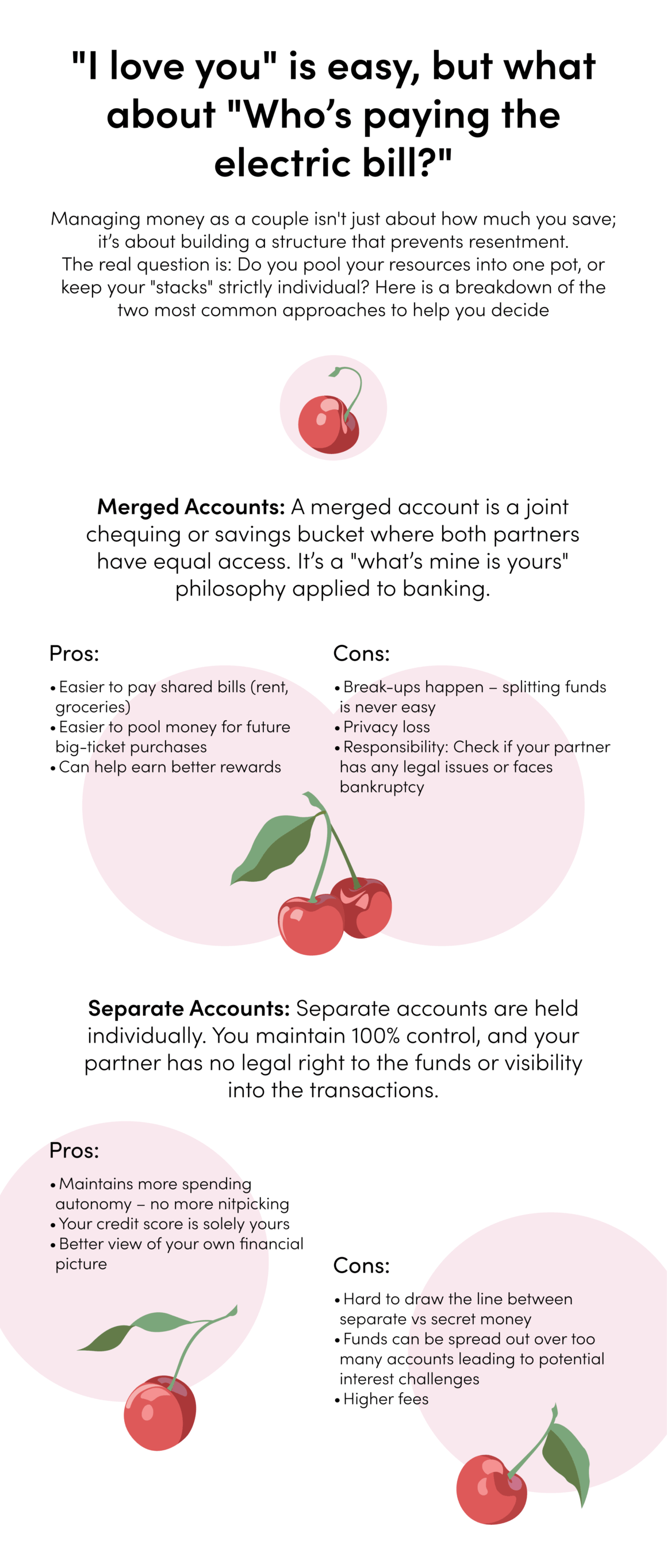
A merged account is a joint chequing or savings bucket where both partners have equal access. This process involves opening a joint account, updating direct deposit accounts, updating automatic payments, and closing old accounts. It’s a “what’s mine is yours” philosophy applied to banking.
Merged account pros and cons
| Pros | Cons |
| Easier to pay shared bills – this can include rent, groceries, coffee bills, or anything you share. | Break-ups happen – it is never easy splitting money. Should you split 50/50? Do you take what you have earned? |
| Easier to pool money for future big-ticket purchases like a car, a home, a nice vacation. | Privacy loss – your partner can see every single transaction you make. Different spending habits can lead to increased arguments and a power imbalance in financial decisions. |
| Better rewards – faster savings growth due to the higher overall balance (you may be able to hit higher tiers for interest rates, which is good for compounding in accounts like HISA). | Overspending risk – if both partners are using the same funds, it can be hard to keep track of the total balance since you don’t know what your partner is spending unless you check. |
| Increased spending volume – transactions usually go through one card which ultimately increases reward points or cash back. | Responsibility – check your partner’s financial red and green flags. See if your partner faces bankruptcy or has any legal issues. |
| Easier budgeting – merged accounts promote the teamwork mindset, where you are provided a clear all-in picture of your combined financial standing. Plus it’s a lot less math! | Debt – your partner’s debt won’t impact you unless jointly liable. However, debts incurred in your relationship are shared equally in the case of separation. |
What is a separate account?
Separate accounts are held individually. You maintain 100% control, and your partner has no legal right to the funds or visibility into your transactions. This account is generally used to isolate certain (or all) funds. It tends to be used for specific goals such as: separating personal funds from others (partner, business), managing household budgets, or simply maintaining financial independence.
Separate account pros and cons
| Pros | Cons |
| Spending autonomy – no more nitpicking. You have control over your own money and spending habits which avoids any potential power imbalances or arguments. | Transparency challenges – it can be hard to draw the line between separate and secret money. With your own account you may feel like you don’t need to budget with your partner. |
| Protection – you are protected from any potential legal issues such as debt collection. Your credit score is also solely yours, protecting you from a partner’s potentially poor score. | Interest challenges – funds can be spread out over too many accounts leading to potential interest challenges (reduced interest). Your money may be spread too thin. |
| Better view of your own financial picture – gives you a better snapshot of your personal spending. It is easier to track your expenses and savings as a whole without being muddied by other transactions. | Higher fees – you may have higher maintenance fees, transaction fees, or trouble maintaining minimum balances. These can stack up without you realizing. |
| Financial literacy – separate accounts make sure that each partner maintains a degree of financial literacy. It’s hard to have a bank account if you don’t know how to use it. | Paying bills can be harder – payments become a lot more complex. Bills need to be split or funds need to be transferred instead of coming from a shared pool. |
| Easier to give – joint account gifts feel less special because they came from shared funds. Separate account gifts represent individual thought and personal expense. | Emergency challenges – in the case of an emergency it may be harder to access funds if the money is under lock and key. |
While some couples like to be all in with the fully merged account, others may prefer some independence with a separate account. Many find romance and practicality meet perfectly with a hybrid approach: joint for shared life, separate for personal choices.
Whatever approach makes the most sense to you, it’s always a good idea to talk to your significant other to determine what is right for you.