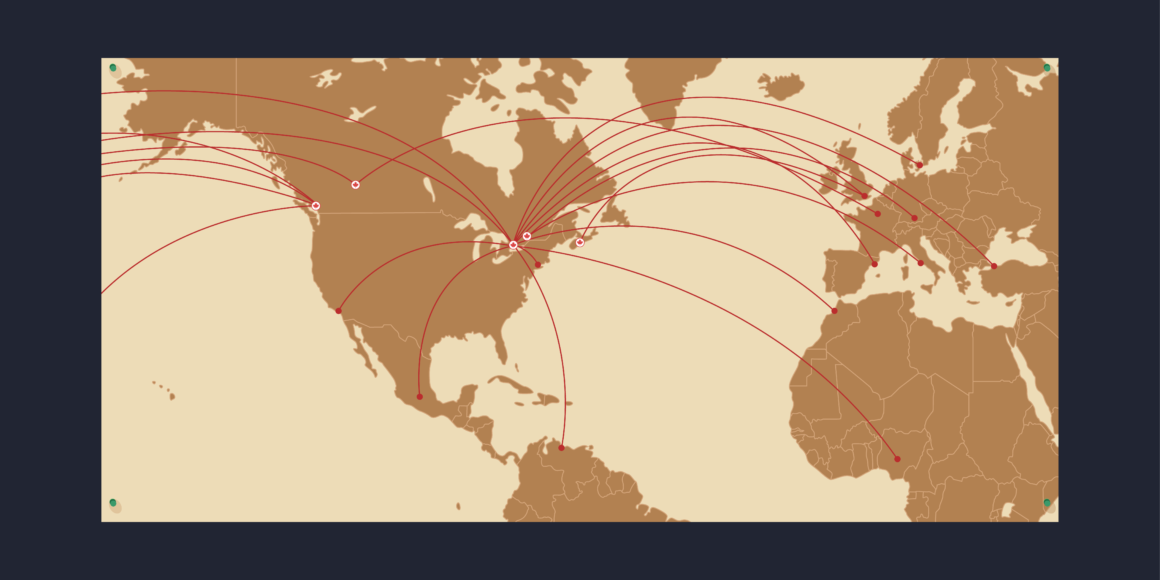

With the U.S. enacting harsh tariffs on major sectors of the Canadian economy and threatening more economic pain with the renegotiation of the U.S.-Mexico-Canada free trade agreement, there’s a push for Canadian money – particularly the more than $4-trillion managed by Canada’s largest pension funds – to be invested at home to boost the country’s economy and long-term resiliency.
Pensioners are asking more questions about where their money is being invested, and other Canadians are questioning why pension funds don’t invest more at home.
That shift has put Canadians pension funds in focus and there have been some signs Canada’s “Maple Eight” – the largest funds in the country – are suggesting that’s a possibility for the right infrastructure projects.
Pension mandates
Most Canadians aren’t familiar with how or where pension funds invest “but over the last year, there has clearly been an evolution in Canadian sentiment about investing in Canada and investing in the United States in particular, and I think it’s impossible for the pension funds to not be aware of that and to not feel that pressure,” says Matthew Mendelsohn, CEO of Social Capital Partners, a non-profit organization focused on public policy and economic security.
Canada’s pension funds have “bristled” at any talk of forcing them to have a dual mandate – to provide long-term for their pensioners and to also invest a certain portion of the fund in Canada – which is the case for Quebec’s Caisse de dépôt et placement du Québec. Funds have stressed that their independence is vital and makes them “powerful, respected, successful, important players globally,” Mendelsohn says, and any interference by the government would lead to a decline in returns.
However, many pension funds globally have a dual mandate to both their pensioners and their country’s economy without the government micromanaging their investment portfolio, he adds, “and they do just fine.”
“I don’t think it is credible anymore for those who manage hundreds of billions of dollars of Canadian pension funds to say we don’t care what the impact is on our economic resilience, or on long-term sustainability, or on productivity in the Canadian economy, all we care about is risk-adjusted market returns,” he explains. Those who manage funds are now asking themselves about their responsibilities, he adds.
“I think that’s a perfectly reasonable question and it should be asked.”
Mounting pressure
Montreal-based fund manager Letko, Brosseau and Associates wrote a letter to the country’s finance ministers in 2024 concerned that Canada’s biggest pension funds had reduced their holdings in Canadian equity investments to about 10 per cent of total assets at that time. They called for changes to the rules for pension funds “to encourage them to invest in Canada” to boost the economy.
Canada’s pension funds, including the Canada Pension Plan (CPP), Ontario Municipal Employees Retirement System (OMERS), Ontario Teachers’ Pension Plan (OTPP) and others, choose investments independently. Pension funds used to invest mainly in Canada with regulations that limited foreign investment to 30 per cent of a fund’s assets. That rule was scrapped in 2005 and since then Canadian pension funds have increased their foreign and U.S. holdings.
There’s a range in Canadian assets in major funds from lower levels near 10-15 per cent to upper levels of near 50 per cent. Many assets are invested in the U.S. Last year, the Canada Pension Plan Investment Board said 12 per cent of the CPP’s assets were in Canada and 47 per cent in the U.S. – its highest level ever.
The removal of the foreign limit allowed pension funds more flexibility to diversify holdings with foreign assets as they aimed to improve the investment performance. Pension funds argued at the time that Canada only represented a fraction of the global market and by restricting access the government was limiting their performance and hindering their ability to provide secure pensions. Now, many critics state that the government should force pensions to invest their money from working Canadians in ways that support the country’s economy.
Shifting sentiment
There are hints that Canada’s pension plans are seeing more opportunity in the country. Last month, OMERS chief executive officer Blake Hutcheson said in a Globe and Mail report that the pension plan was looking to increase new investments in Canada by at least $10-billion over the next five years, to about 25 per cent of its assets. The fund currently has about 18 per cent, or $26-billion, of its $145-billion portfolio invested in Canada.
“What’s really changed is the conditions that are being created are much better,” Hutcheson said in the article. “There’s more in the window.”
Last fall, the CEOs of Canada’s major pension funds told a Toronto business audience that governments need to sell key infrastructure including airports, hydroelectric power plants and highways so the country’s pensions can invest in them – assets they have bought elsewhere in the world.
Incentivizing investment
That’s the key to getting Canadian pension funds more interested in investing in Canada, says Luciano Arvin, a political economist who writes about the intersection of finance and politics and has written for Policy Options, the Canadian Centre for Policy Alternatives and the Harvard International Review.
“I would categorically reject saying there should be any mandate that Canadian pension funds invest in Canada, but I strongly believe that conditions should be put in place to try and incentivize them,” Arvin says.
That includes faster permitting and approval of major projects on both the federal and provincial levels, which has been “lethargic.” The government can also set stronger “buy Canadian” procurement policies with defense and other industries “to give investors long-term certainty.” Offering more partnering opportunities between pension funds and certain government agencies such as the Canada Infrastructure Bank could allow pension funds to invest in “shovel ready investments,” he adds.
Prime Minister Mark Carney has also made some moves to lure more investment in Canada, like establishing a Sovereign Wealth Fund to promote Canadian investment. This fall, the government is hosting the inaugural Canada Investment Summit to target top global investors and pension funds aiming for $1-trillion in investment over five years.
Required changes
According to Mendelsohn, there are three main changes that need to occur for Canada’s pension plans to invest more in the country. First, they have to want to invest in Canada and that requires a culture change along with pressure from Canadians for pensions to “fulfill their Canadian responsibilities.”
Secondly, markets need to advance and produce investable products that interest pensions, beyond selling off airports or offering real estate investment trusts, he says. That needs to include funds pensions can invest in that focus on mid-size companies, tech firms, or non-market housing projects. Pensions won’t do smaller $5-million investments in a single company but would invest larger amounts in a fund doing due diligence on a group of smaller firms, he adds.
Lastly, pension funds need to devote more resources, talent and change governance to seek out these different, Canadian opportunities.
“If you’re not organized across asset classes and across geographies to look for certain things, you’re not going to see them,” Mendelsohn says.
“You have to be organized and govern in a way that cares about and seeks out resilient, productive, sustainable Canadian investments.”