
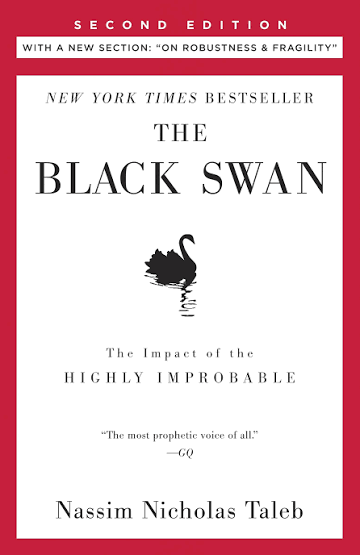
“History and societies do not crawl. They make jumps” – Nassim Nicholas Taleb
The Black Swan by Nassim Taleb explores the unrecognized role that randomness and highly improbable events play throughout our lives.
Taleb argues that many of the biggest events in business, history and investing are impossible to predict, yet people often convince themselves afterward that these events were obvious all along.
Throughout the book, Taleb introduces two contrasting types of randomness: Mediocristan, where no single outlier or extreme observation can drastically skew the total result, and Extremistan, where a single outlier or extreme event can disproportionately impact the total, making averages meaningless.
Through these concepts, Taleb challenges the reader to rethink how they approach risk and uncertainty.
Key Takeaways
- Black swans depend on perspective. One of the examples that stuck with me the most was Taleb’s story about the turkey. Every day the turkey is fed and cared for, so it becomes more confident that tomorrow will be just like the last day. Then Christmas arrives, and everything changes in an instant. From the turkey’s perspective this is a Black Swan event as it was completely unexpected. This example shows Black Swan events are often about perspective. An event that seems obvious or predictable to one person can be completely unimaginable to someone else.
- We often apply predictability where it doesn’t belong. Taleb makes a strong case that people are too quick to use statistics like the normal bell curve to explain situations that belong in the Extremistan category. In these environments, a single event or person can completely change the outcome, making averages much less useful than we think. Whether it’s financial markets, technology or global events, rare outliers often have a much greater impact than the steady patterns we expect. This changed the way I perceive risk as it highlighted how easily we underestimate the chances of extreme outcomes.
- We create stories that make the past seem more predictable than it really was. Another concept I found interesting was Taleb’s concept of the narrative fallacy. He argues that once an event has happened, our brains naturally build a story that makes the outcome seem logical and inevitable. “We are much better at explaining than predicting,” he writes. We ignore the uncertainty and many possibilities that existed beforehand. We also tend to predict the future based on what has happened in the past, leaving us blind to events that have never occurred before. This takeaway reminded me that confidence in a prediction does not necessarily mean that it is completely accurate.
What I Loved
One of my favourite aspects of the book was how Taleb uses real-world examples and thought experiments to explain complex concepts. The examples, such as the Christmas turkey, made an abstract idea about uncertainty much easier to understand and remember.
I also enjoyed the fact that the book made me question ideas I have always accepted, particularly around prediction, decision making and how we interpret history. Taleb wasn’t afraid to challenge and disagree with the commonly-accepted theories and explain why they can be misleading. The concepts in this book applied to life outside of investing.
What I Didn’t Love
The vocabulary and writing style could be difficult to follow at times, since Taleb uses advanced language throughout the book which made it a slower read than expected. Some concepts were repetitive, and many historical references required outside research and I often found myself Googling people or events to fully understand the examples.
Who Should Read This Book?
The Black Swan is great for advanced readers who are early in their careers as the lessons throughout the book may shape or add value to the way they approach decision making as they advance through their careers.
Final Verdict
I would recommend this book. It covers concepts that are often overlooked and offers valuable insight into how we think about uncertainty, risk and highly improbable events. Although it can be a challenging read, I believe the perspective it provides makes it well worth it.