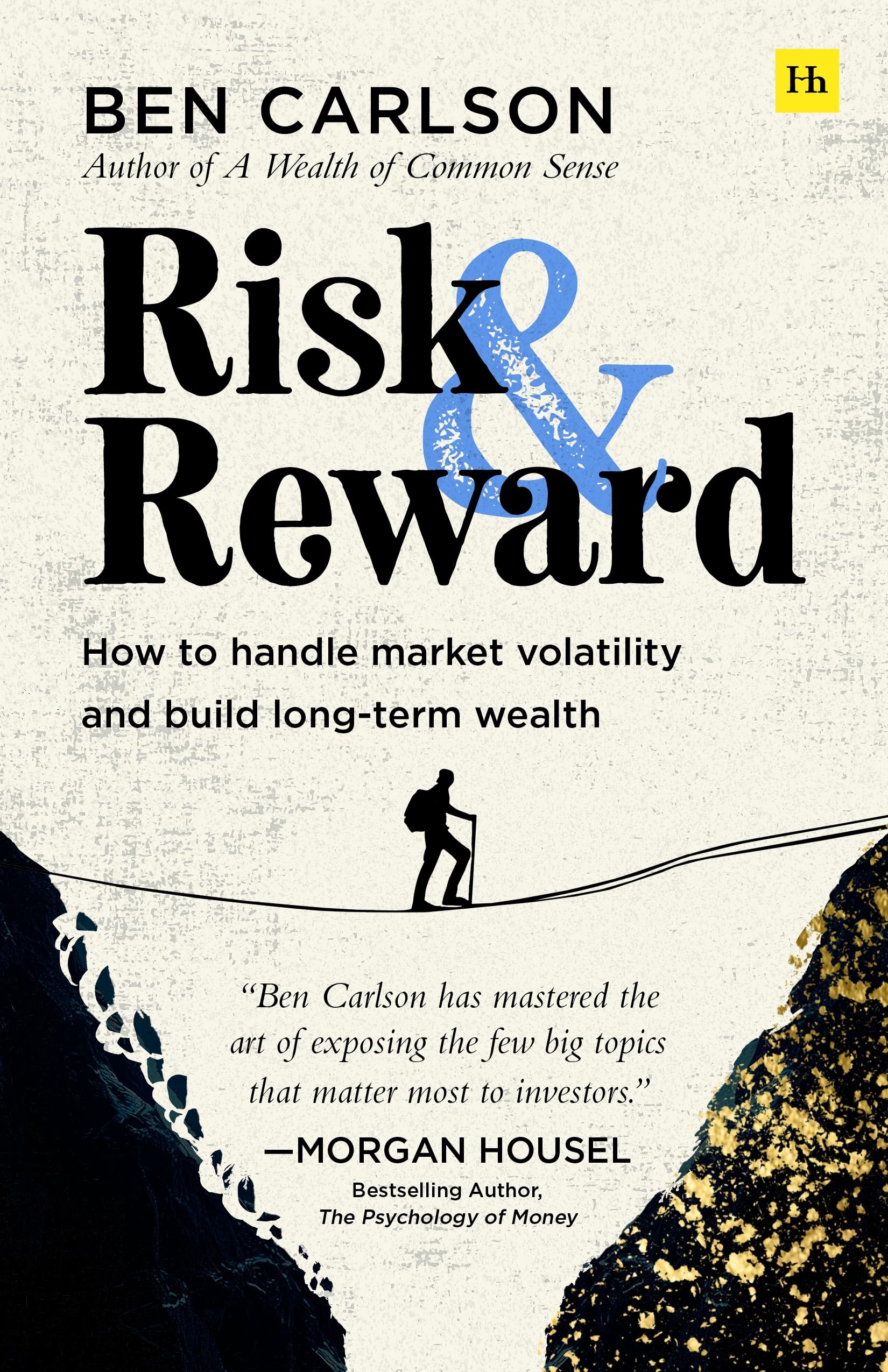
The central message of Ben Carlson’s Risk and Reward: How to Handle Market Volatility and Build Long-Term Wealth argues that successful investing comes from understanding risk, accepting uncertainty and staying disciplined over long periods of time.
Through historical case studies ranging from the Great Depression to Japan’s stock market collapse and the 2008 financial crisis, Carlson examines how investors can navigate volatility while building long-term wealth.
Key Takeaways
- The importance of learning from history: Carlson’s discussion of events such as the Great Depression, the 1970s inflation period, the Japanese asset bubble and the 2008 financial crisis showed how different market environments challenge investor expectations. Japan demonstrated that markets do not always recover quickly, inflation showed that cash is not always safe and crashes showed that volatility is a normal part of earning long-term returns.
- The power of compounding and the importance of staying invested during difficult periods: Carlson highlights that while crashes are emotionally memorable, long-term wealth creation comes from allowing returns to compound over decades. Despite recessions and market declines, the U.S. stock market has historically generated roughly 10 per cent annual returns before inflation over long periods. This reinforces Carlson’s message that short-term declines do not determine long-term outcomes, but rather create opportunities for patient investors.
- Diversification as one of the most effective forms of risk management: Instead of focusing only on finding the next big winner, investors should avoid catastrophic mistakes. Carlson explains that “diversification is one of the best forms of risk management because it helps you avoid extremes.” While diversification may limit exposure to the best performer, it also protects investors from being fully exposed to the worst.
“The young man knows the rules, but the old man knows exceptions.” – Ben Carlson
What I liked
● Carlson challenged his own philosophy instead of only supporting it. One of the strongest parts of the book was that Carlson did not ignore examples that challenged long-term investing. His discussion of Japan showed that he understood there are exceptions to every investing rule, making his arguments feel more balanced and realistic.
● The historical examples made complicated financial events easy to understand. Carlson explained events such as the Great Depression, the 2008 financial crisis and the Japanese stock market collapse in a way that was simple without becoming overly technical. These examples made the lessons a lot more concrete.
● Each chapter introduced a new element of his investing philosophy. The book did not simply repeat the idea of “buy and hold.” Instead, each chapter explored different aspects of investing, including risk, emotions, diversification, uncertainty, and patience.
What could be improved
● The book sometimes relied too heavily on graphs showing long-term market returns. While these charts supported Carlson’s argument, there were moments where the same message was repeated multiple times. Fewer graphs with more detailed explanations could have made the strongest points more impactful.
● The book could have included more discussion of professional investing. Carlson provides an excellent framework for individual investors, but I would have liked more examples of how these principles apply to institutional investors, active managers, or professional investors. More discussion of portfolio construction and investment decision-making would have added another layer of depth.
● Some concepts may feel familiar to experienced investors. Ideas such as diversification, patience, and avoiding emotional decisions are not completely new. However, Carlson’s strength is not necessarily introducing new investment theories, but explaining timeless principles through historical examples.
Final Verdict
I would recommend Risk and Reward to anyone looking to develop a stronger understanding of investing. It’s valuable for beginner investors and anyone who struggles with market uncertainty because Carlson provides the historical context needed to understand why volatility is a normal part of investing. While experienced investors won’t learn new strategies, they will still benefit from the reminders about humility, diversification and emotional discipline. However, readers looking for technical investing methods, valuation frameworks, or stock-picking strategies may find the book less applicable. Ultimately, Carlson’s greatest lesson is that investors cannot eliminate uncertainty, but they can control how they respond to it. As Carlson writes, “sometimes the worst of times can be the best of times.” The book serves as a reminder that difficult market environments are not only periods of risk, but also opportunities for patient investors who allow time and compounding to work in their favor.