

Canada’s largest pension funds collectively allocate an average of ~11% of their public equity portfolios to Canadian companies.
Disclosures from major institutions indicate that Canadian equities play a consistent role within broader asset-allocation frameworks. These investments provide capital to publicly listed Canadian businesses across a range of sectors and are integrated alongside global equity, fixed income, and private asset strategies.
This article outlines domestic equity allocations among select Canadian pension funds and presents information on how domestic equity exposure is structured in other jurisdictions.
Canadian Pension Funds: Public Equity Allocation Overview
Based on the most recent public filings from the Canada Pension Plan Investment Board (CPP Investments), Caisse de dépôt et placement du Québec (CDPQ), British Columbia Investment Management Corporation (BCI), and Ontario Municipal Employees Retirement System (OMERS), public equities represent a meaningful component of overall portfolio assets.
Within public-equity allocations, Canadian pension funds distribute capital across Canadian, U.S., and other international markets.
Summary of Public Equity Allocations (Select Canadian Pension Funds):
- Public equities account for approximately 24% of total portfolio assets on average (Figure 1).
- Within public equities:
- ~11% is allocated to Canadian equities
- ~53% to U.S. equities
- ~36% to global (non-North American) equities
These figures illustrate how domestic exposure fits within diversified public equity portfolios and the structural considerations that guide regional allocation decisions.
Figure 1
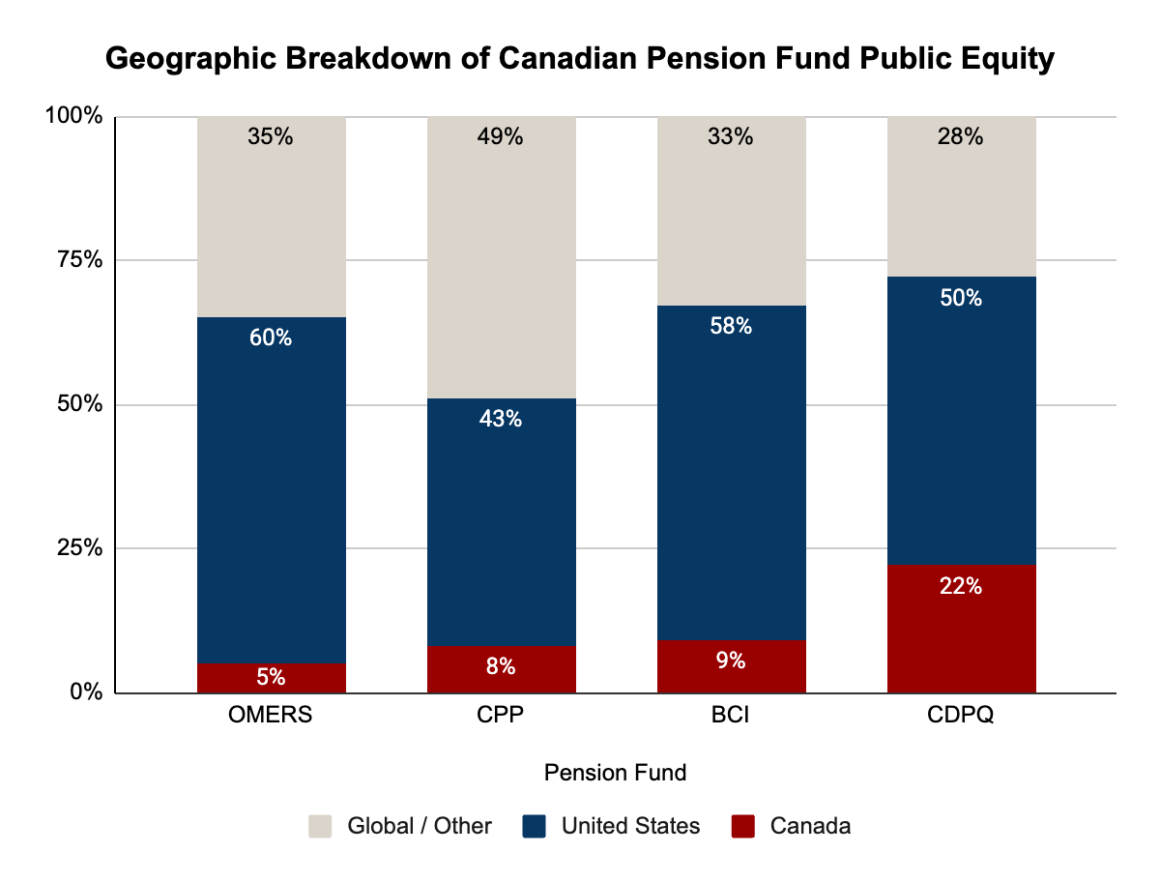
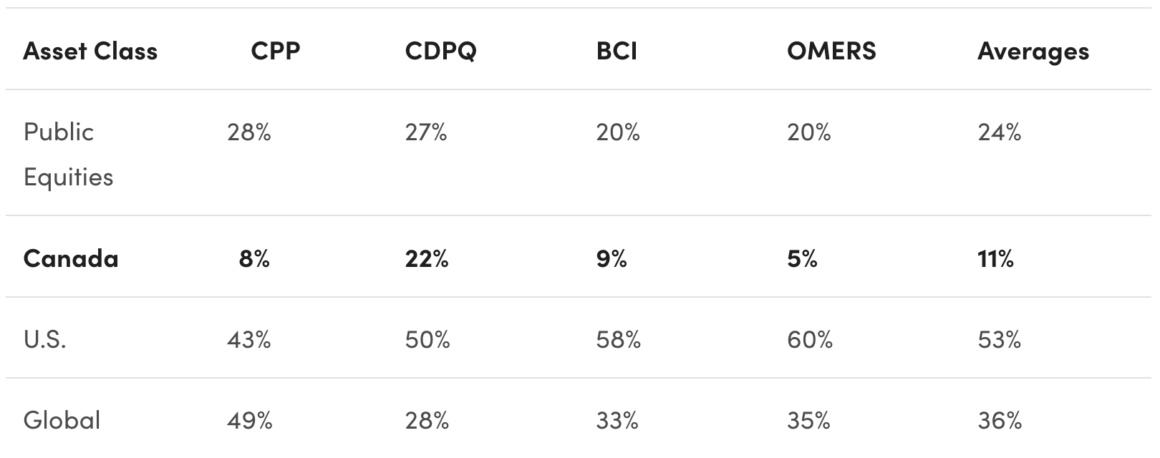
Source and additional notes: CDPQ data as of December 31, 2024.¹ CPP data as of March 31, 2024.⁵ BCI data as of March 31, 2024.⁴ OMERS data as of December 31, 2024.² Global includes a small sleeve of Canada and US equities.
To provide context for the role of domestic equity within public equity portfolios, it is useful to consider the structure of Canada’s public markets.
Structural Context for Canadian Equity Investments
Canadian pension funds and endowments operate within a domestic market characterized by:
- A stable regulatory environment
- Established governance standards
- Public companies concentrated in specific sectors
The S&P/TSX Composite Index reflects this structure, with the financials, energy, and materials sectors collectively representing approximately 68% of index weight as of January 31, 2026. Exposure to these sectors provides institutions with access to industries that are integral to Canada’s economic framework.
From a market-characteristics perspective:
- Canadian financial institutions operate within a regulated, oligopolistic system.
- Energy and materials companies reflect Canada’s natural-resource base; and
- Public markets provide liquidity and transparency relative to private investments.
These features might form part of the investment context in which Canadian equity allocations are made.
International Pension Funds: Domestic Equity Allocations
Looking beyond Canada, allocation patterns vary widely across global pension systems. Institutional investors in other jurisdictions also allocate a defined portion of their public-equity portfolios to
domestic companies. These allocations typically reflect each fund’s regulatory framework, domestic market structure, and investment mandates.
Public disclosures from large global pension funds indicate the following domestic equity allocations within public-equity portfolios (Figure 2):
- Australia: The Australian Retirement Trust reports that approximately 49% of its public-equity exposure is invested in Australian-listed companies.
- Switzerland: The Swiss Federal Pension Fund (PUBLICA) allocates approximately 24% of its equity portfolio to Swiss equities.
- Sweden: Sweden’s Andra AP-fonden maintains approximately 23% of its equity exposure in Swedish-listed public companies.
- Japan: Japan’s Government Pension Investment Fund reports that approximately 50% of its equity exposure is allocated to Japanese equities.
Figure 2
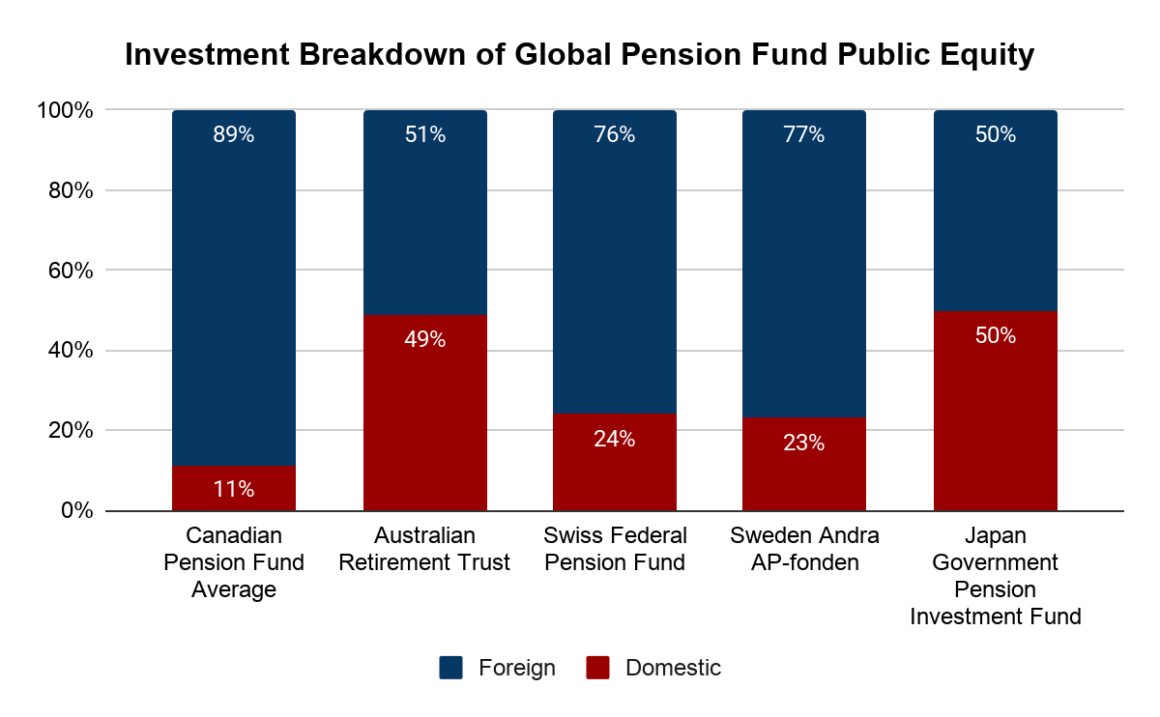
Source and additional notes: ART data as of September 30, 2025.⁹ PUBLICA data as of December 31, 2024.⁶ AP2 data as of December 31, 2025.⁸ GPIF data as of December 31, 2025.⁷ Canadian Pension Fund Average includes: CPP, CDPQ, BCI, and OMERS.
Overall, the figures indicate that domestic equities continue to represent a stable component of institutional public equity portfolios within broader global allocations. Differences observed across international systems largely reflect variations in mandates and market structures. Allocation levels are influenced by the relative size of domestic capital markets, the available investment opportunities, currency considerations, and fund-specific fiduciary requirements.
References
- “2024 Annual Report.” CDPQ, CDPQ, 31 Dec. 2024, www.cdpq.com/sites/default/files/medias/pdf/en/ra/2024_cdpq_annual_report.pdf.
- “2024 Annual Report.” OMERS, OMERS, 31 Dec. 2024, downloads.ctfassets.net/iifcbkds7nke/2ign1jtOjM61MIjilFQBWw/666fff978559befebb09d963218d07a8/OMERS_2024_Annual_Report_FINAL-ua.pdf.
- “Annual Financial Report April 30, 2025.” UWaterloo, University of Waterloo, 30 Apr. 2025, uwaterloo.ca/finance/sites/default/files/uploads/documents/audited-financial-report-april-30-2025-accessible.pdf.
- “Annual Report – Bci Corporate Annual Report 2024-2025.” BCI, BCI, 31 Mar. 2024, uberflip.bci.ca/i/1536830-bci-corporate-annual-report-2024-2025/16.
- “Annual Report 2024 25 Years of Investing.” CPP Investments, CPP, 31 Mar. 2024, www.cppinvestments.com/wp-content/uploads/2024/07/CPP-Investments-F2024-Annual-Report.pdf.
- “Annual Report 2024.” PUBLICA, 2024, publica.rokka.io/dynamic/noop/c679c7af3ab9a3cdca13dc82d3817778eda88ef0/2025-04-28-publica-gb-2024-en-web.pdf.
- “Annual Report Fiscal Year 2024 Government Pension Investment Fund.” Japan Government Pension Investment Fund, 2024, www.gpif.go.jp/en/performance/annual_report_fiscal_year_2024.pdf.
- “Annual-Report-2024.” AP2, 2024, ap2.se/wp-content/uploads/2025/03/Annual-Report-2024.pdf.
- “Investment Reports.” Australian Retirement Trust, 30 Sept. 2025, www.australianretirementtrust.com.au/investments/performance/reports.
- Betermier, Sebastien. “Canada’s Pension Plan Is the Envy of the World, and Now We Know Why.” McGill Delve, McGill, delve.mcgill.ca/read/canadas-pension-plan-is-the-envy-of-the-world-and-now-we-know-why/. Accessed 17 Feb. 2026.
Disclaimer
®Lysander Funds is a registered trademark of Lysander Funds Limited.
Lysander Funds Limited pays a fee to Financial Pipeline to post content on their website, which may be construed as promotion of Lysander Funds Limited, its affiliates or the Lysander Funds. Lysander Funds Limited and Financial Pipeline are affiliates.
The views and information expressed in this article are for informational purposes only. They are not intended as investment, financial, legal, accounting, tax or other advice and should not be relied upon in that regard. Commissions, trailing commissions, management fees and expenses all may be associated with mutual fund investments. Please read the prospectus before investing. Investment funds are not guaranteed, their values change frequently and past performance may not be repeated.
This document may contain forward-looking statements. Statements concerning a fund’s or entity’s objectives, goals, strategies, intentions, plans, beliefs, expectations and estimates, and the business, operations, financial performance and condition are forward-looking statements. The words “believe”, “expect”, “anticipate”, “estimate”, “intend”, “aims”, “may”, “will”, “would” and similar expressions and the negative of such expressions are intended to identify forward-looking statements, although not all forward-looking statements contain these identifying words. These forward- looking statements are subject to various risks and uncertainties that could cause actual results to differ materially from current expectations. Readers are cautioned not to place undue reliance on these forward-looking statements. While the authors of this article consider these risks and uncertainties to be reasonable based on information currently available, they may prove to be incorrect.